MakeNTU

May 8–10, 2026
The brief
AUO makes display panels, and the sponsor prompt came down to a single question: if the windshield itself becomes the display, what is actually worth putting on it? The easy answer is a bigger speedometer. We treated it as an interface problem instead — the glass should show what the driver’s current state calls for, and stay out of the way otherwise.
What we built
A first-person driving simulator that runs entirely in the browser, built on real map data: the Xinyi district road network pulled live from OpenStreetMap Overpass, routes from OSRM, and procedurally generated buildings filling the blocks in between. Four scenarios ship — city, highway, coastal drive, and a parked rest stop.
The windshield is composed in four layers, so the result reads as glass rather than as a game overlay:
| Layer | What is in it |
|---|---|
| 4 · Glass | Vignette, film grain, top tint, A-pillars and mirror silhouettes |
| 3 · HUD | Frosted DOM/SVG panels — speed, compass, nav card, ETA, climate, now playing, minimap |
| 2 · AR | POI cards projected into screen space onto building facades, fading when occluded |
| 1 · World | Three.js — roads, buildings, cabin, traffic agents, route arrows, destination pillar |
And the subsystems that make it more than a renderer:
| Subsystem | How it works |
|---|---|
| Driver monitoring | MediaPipe FaceLandmarker blendshapes feed one state machine with two outputs. Hard warning: both eyes shut past 1.2 s, cooldown-gated so it does not machine-gun at a driver who is genuinely asleep. Continuous 0–1 fatigue score: rolling PERCLOS (a one-minute EMA of eyelid closure) combined with yawn rate — a jaw held open past 0.55 for 800 ms counts as a yawn, over a two-minute window. |
| Fatigue-driven HUD | The score is the interesting half. As fatigue climbs the HUD raises contrast on rear traffic, sheds non-essential chrome, and drifts wake-up particles across the glass — the display responds to the driver instead of shouting at them. |
| Head-pose lane-change intent | Looking more than 18° to one side for 800 ms reads as a shoulder check, and the panel surfaces rear traffic in that adjacent lane. Releases at a looser 8° with a 500 ms cooldown — hysteresis, so a brief glance forward does not flicker the panel on and off. |
| Door-opening safety gate | In rest mode the car is parked roadside with traffic flowing past. Asking to get out forward-simulates the traffic schedule: if any vehicle will come within 12 m of the door in the next 4 s the gate stays red, otherwise a tap confirms. |
| Voice + AI reservation call | Speech recognition is always listening. Say 「找餐廳」and five nearby POIs come back from Overpass; pick one by number and the in-car assistant dials it, speaking a reservation script over TTS while the overlay renders the transcript as chat bubbles. Phone numbers carry a separate spoken form so Chinese TTS reads them digit by digit instead of turning 09 into a place value. |
| Four-screen cabin | Each screen runs the same app with ?role=driver / passenger / left / right. The driver publishes state snapshots to a small WebSocket relay that fans them out unparsed; each role applies its own camera offset — passenger 0.45 m inboard of the right door, side windows yawed ±90° — and keeps its own mouse-look on top, so a passenger can still turn their head independently. |
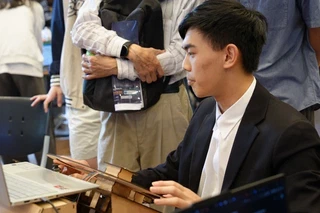
| Physical steering wheel | You drive it with an actual wheel. Steering angle comes off a six-axis IMU (three-axis accelerometer plus gyroscope) mounted on the wheel itself, so the rotation is read directly from how the wheel moves — no shaft encoder or mechanical end-stops to fabricate in three days. An Arduino Nano packages the reading as one JSON line per packet at 115200 baud, roughly 20 packets a second, which the browser reads through Web Serial. Every value is clamped on arrival so a noisy reading cannot push the vehicle physics past its own caps, and the 60 fps render interpolates between packets rather than stepping. |
My role
I was the team lead. The sponsor prompt named a display, not a product, so most of the work up front was deciding what a windshield should actually do — I ran that ideation with the team, and then led the software side through to a working demo. My own commits landed the highway, coastal and rest-stop scenarios, the driver-monitoring pipeline and everything the fatigue score drives, collision handling, the head-pose lane-change intent, and the exit gate.
Roughly 20k lines of TypeScript went in over the three days, with 194 unit tests across 16 files covering the pure logic — the state machines, geometry and traffic simulation are all written as pure functions precisely so they could be tested at hackathon speed instead of debugged through the UI.
Results
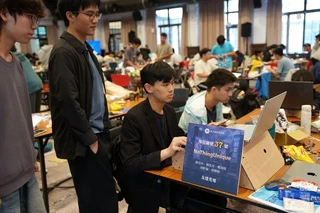
First place, AUO corporate award.
