RecoveryDAgger
Sep – Dec 2025
The problem
Imitation learning lets an agent pick up complex behaviour from expert demonstrations, but plain behaviour cloning drifts. Small errors push the agent into states the expert never demonstrated, and from there the mistakes compound.
DAgger fixes the drift by querying the expert on the states the learner actually visits. That works, but it asks constantly — and expert supervision is the expensive part of the whole setup.
What we built
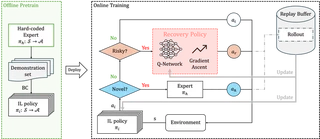
RecoveryDAgger keeps DAgger’s interactive loop but adds a cheaper first response to trouble. In a risky state the agent does not call the expert straight away. It first runs a recovery policy that corrects itself locally by ascending the gradient of a learned Success Q-function — a network that estimates the probability the task will still be completed from the current state. The expert is queried only when recovery is unreliable, which is to say only when the state is genuinely novel.
The point is to spend expert supervision on new information, rather than on situations the agent could have dug itself out of.
My role
I led a four-person team and built the expert policy and the training pipeline myself, in PyTorch and Stable-Baselines3. The expert is a rule-based controller that steers toward the goal from the current state — deterministic, 100% success on the task — and it generates the 100-trajectory offline dataset every method in the paper starts from. Behaviour cloning on that dataset lands at roughly 26% success, which is exactly the gap online training has to close.
The design decision I care most about is how recovery actually produces an action. PointMaze has a continuous action space (forces along x and y), so the obvious version of recovery — enumerate candidate actions, take the arg max of the Success Q-function — is not available. We instead start from the action the imitation policy already proposed and run a few steps of gradient ascent on the Success Q-function with respect to the action, projecting back into the valid range after each step. Recovery is a local correction of the policy’s own intent, not a second controller fighting it.
The other decision was to stop trusting a single Q-network. One learned Success Q is only an approximation, and recovery follows its gradient, so its errors get amplified rather than averaged out. We trained an ensemble instead: the ensemble mean defines risk, the ensemble variance defines novelty, and the recovery objective subtracts a penalty λ·Var(Q) so recovery never climbs toward states the ensemble disagrees about. One family of networks ends up serving all three roles — risk detector, novelty detector, and recovery direction.
Results
Evaluated on a four-room PointMaze navigation task against ThriftyDAgger, the standard query-efficient baseline. Every method starts from the same behaviour-cloned policy.
| Method | Expert queries | Recovery queries | Success rate |
|---|---|---|---|
| Behaviour cloning | — | — | 0.26 |
| ThriftyDAgger (baseline) | 20,048 | — | 0.81 |
| Single-Q recovery (ours) | 2,504 | 9,232 | 0.86 |
| Ensemble-Q recovery (ours) | 2,693 | 9,296 | 0.88 |
Ensemble-Q recovery ends up more accurate than the baseline while querying the expert 7.4× less often. Partway through training the gap is even wider: both recovery variants reach ~0.7 success after about 2k expert queries, where ThriftyDAgger needs roughly 20k to get to the same place.
The interesting part is where the savings come from. Most of what a risk-gated method spends its query budget on is not genuinely unfamiliar — it is recoverable: local deviations near a doorway or a wall that the agent could fix by itself. Separating “novel” from “merely risky” is what buys the 7.4×.
The project placed 3rd among 30 teams, most of them graduate students, and the work has been accepted to IEEE Potentials.
